Data Center 101

Curious about data centers?

You don't need a CS degree, a tech background, or a clear plan. You need curiosity and a starting point. This page is the starting point. Read it top to bottom in about ten minutes and you'll know what data centers are, what kinds of people thrive in them, what to learn first, and exactly who to talk to next.

First, the basics

What is a data center?

A data center is a building full of computers that run the modern world. Every search, stream, transaction, AI prompt, and cloud app you use lives on hardware inside one. Arizona is one of the fastest growing data center markets on the planet because of cheap power, dry air, available land, and low natural disaster risk.

Compute

Servers, GPUs, and storage that run software. Think rows of refrigerator sized racks, each holding dozens of computers.

Power

Massive electrical systems with utility feeds, transformers, switchgear, UPS battery backups, and diesel or gas generators.

Cooling

Chilled water plants, CRAH units, evaporative systems, and increasingly direct to chip liquid cooling for AI workloads.

Operations

24/7 monitoring, security, compliance, and the technicians who keep everything running through any weather, any hour.

A useful mental model

A data center is part power plant, part HVAC project, part computer hardware, part construction site, and part security operation. That's why so many different backgrounds fit into it. Electricians, plumbers, network technicians, mechanics, military veterans, project managers, and people coming straight out of community college all find a home here.

Fast Start • No Cost

Start with a free course. Get placed in a paid internship.

No degree, no prior experience, no tuition. AZDCA's fastest entry path starts with a free, employer-designed online course that begins with a personalized skills assessment, builds a profile of your strengths, and maps you to a real data center role. Finish the course, meet with AZDCA, and we refer you into a paid internship with one of our member employers.

Is this for you?

Who thrives in data centers

There's no single profile. The industry needs every kind of brain and every kind of hands.

You like fixing things

If you'd rather take something apart than scroll through it, data centers are wall to wall hands-on systems. Mechanical, electrical, network, cooling, and physical security all need people who can troubleshoot in real time.

You like patterns

Operators stare at dashboards full of temperatures, pressures, voltages, and traffic flows. If spotting "that's not normal" before anyone else does sounds satisfying, this is your kind of place.

You like teams

Nothing in a data center happens alone. Shifts, change windows, project handoffs, vendor coordination. If working shoulder to shoulder with reliable people sounds good, you'll fit.

You're trade trained

Electricians, HVAC techs, plumbers, controls specialists, low voltage installers, welders, and millwrights are some of the most in-demand people on every Arizona project right now. Bring your card.

You served

Military veterans translate directly. Comms, power generation, mission critical operations, security clearance work, and disciplined shift culture are all native concepts in data centers.

You're switching careers

Plenty of people in this industry came from retail, restaurants, warehousing, or completely unrelated fields. Entry level operations and facilities roles are designed to train you on the job.

Keeping it real

Some of the time, data center work looks like shifts, on-call, weekends, or walking into a 95 degree hot aisle in a hard hat. Construction phases can mean job sites, dust, and weather. Operations phases mean strict procedures and zero tolerance for skipping steps. That's part of the job, same as any skilled trade or mission critical field.

And it's also part of a job with unusual upside. Inside this industry there is real career mobility: technicians move into engineering, field hands move into project management, operators move into facility leadership, and people who started stocking parts end up running entire sites. The physical work and the career ladder are the same job.

The payoff is real money, skills that travel anywhere power and cooling exist, and ownership over physical infrastructure that actually matters.

The Roles

Where you might land

Six broad lanes. Most people end up moving between them over a career.

Critical Operations

The 24/7 team that keeps the building running. Watch alarms, run procedures, lead change windows, respond to incidents.

Entry titles

Critical Environment Operator, Data Center Technician, Facilities Operator

Growth titles

Critical Facilities Tech, Shift Lead, Operations Manager, Site Reliability Lead

Electrical & Power

Everything from utility tie-ins down to PDUs at the rack. Switchgear, generators, UPS, batteries, transfer schemes.

Entry titles

Apprentice Electrician, Electrical Assistant, Battery Tech, Generator Helper

Growth titles

Electrician, Electrical Engineer, Generator Tech, Power Systems Engineer

Mechanical & Cooling

Chillers, cooling towers, pumps, CRAHs, controls, water treatment, and the new wave of liquid cooled AI hardware.

Entry titles

Mechanical Helper, HVAC Apprentice, Water Treatment Tech, BMS Operator

Growth titles

HVAC Tech, Mechanical Engineer, Controls Tech, Liquid Cooling Specialist

Network, Hardware & IT

Structured cabling, fiber, server installs, rack builds, smart hands, network ops, and the core IT tracks taught at Mesa Community College and the Estrella Mountain Microsoft Datacenter Academy.

Entry titles

Rack & Stack Tech, Structured Cable Tech, Smart Hands Tech, IT Support Tech

Growth titles

Network Tech, Hardware Engineer, Field Service Engineer, Deployment Lead

Construction & Trades

Building the next data hall. General contracting, MEP subcontractors, commissioning, project controls, safety.

Entry titles

Apprentice, Construction Laborer, Field Engineer Intern, QA/QC Assistant

Growth titles

Journeyman, Foreman, Superintendent, Project Manager, Commissioning Agent

Security & Compliance

Physical security officers, access control, badging, audit prep, SOC analysts, environmental health and safety.

Entry titles

Security Officer, Access Coordinator, Badging Specialist, EHS Assistant

Growth titles

Security Supervisor, Compliance Analyst, EHS Specialist, Site Security Manager
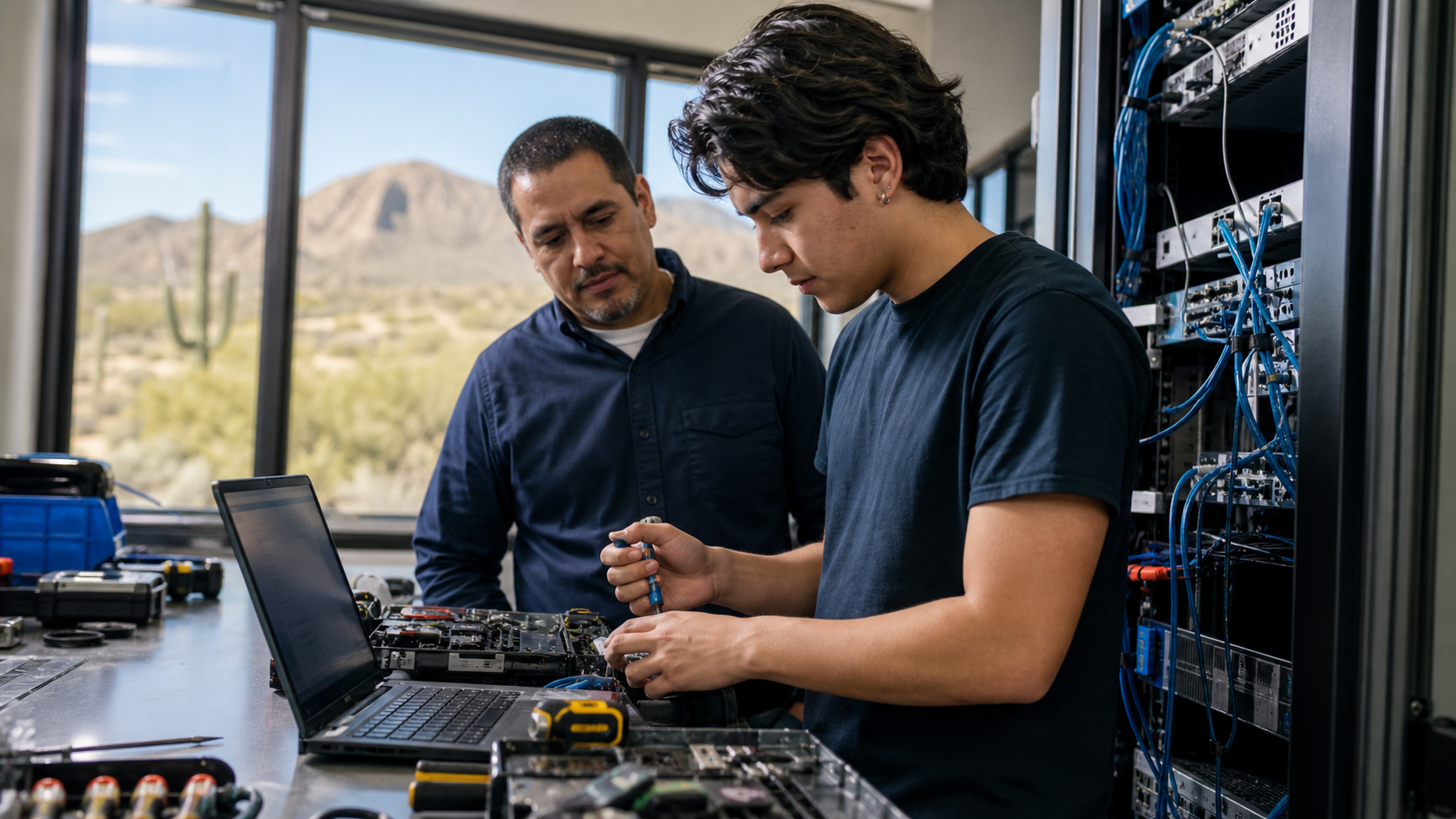
Why these entry titles matter: Rack and Stack Tech, Structured Cable Tech, and Critical Environment Operator are the three most common on-ramp roles our AZDCA members hire for out of free and low cost training. You can be placement ready in weeks, not years.

The Roadmap

What to learn first

You don't need to learn everything. You need to learn enough to ask good questions and prove you're serious.

01

The vocabulary

Spend an afternoon with the basic terms. You'll listen to interviews, podcasts, and tours twice as well after this.

Look up: hyperscale, colocation, edge, rack, U, cabinet, hot aisle, cold aisle, PDU, UPS, ATS, switchgear, MV vs LV, CRAH, chiller, cooling tower, PUE, WUE, tier rating, commissioning, change window, MOP, SOP, EOP.

02

A free intro course

Pick one structured intro and finish it. Finishing matters more than which one.

Good starting points: a CompTIA A+ or Network+ overview, a free Coursera or edX cloud computing intro, AWS Cloud Practitioner essentials, or Cisco's free Networking Basics on the Networking Academy.

03

A first credential

Pick the one closest to where you're already strong. You only need one to start showing up on resumes.

Common entry credentials: CompTIA A+ or Network+, BICSI Installer 1, OSHA 10 or 30, EPA 608 (HVAC), NFPA 70E electrical safety, DCA from CNet Training, or a community college data center certificate.

04

Local programs

Arizona has free or low cost workforce programs built directly for this industry: the Mesa Community College Data Center Operations CCL, the Microsoft Datacenter Academy at Estrella Mountain and Glendale, the Estrella Mountain CCL #5293, plus ASU and SciTech Institute tracks. Scholarships exist.

See the full list on Workforce Resources
05

Learn the players

Knowing who builds, owns, and operates Arizona facilities makes interviews dramatically better.

Skim our Community page to see who's active here: hyperscalers, colocation operators, MEP contractors, commissioning firms, cooling vendors, and the trade groups around them.

06

Show up

Once you've done a little homework, get in a room with people who already do this work. It's the single highest leverage thing on this list.

Career Days, AZDCA mixers, community college info sessions, AFCOM and 7x24 Exchange chapter meetings, and trade shows like NVIDIA GTC and Yotta when they hit Arizona.

The real shortcut: pick one credential, one local program, and one event in the next 30 days. Three commitments. That's the entire entry plan.

Conversations

Who can you talk to?

You don't have to figure this out alone. Here's the actual shortlist of humans worth reaching out to.

AZDCA directly

We're a non-profit run by people in this industry. Email us with where you are and what you're curious about and we'll point you at the right person, program, or event. There's no catch.

Contact AZDCA

A community college advisor

Maricopa and Pima both have advisors who specifically work with the data center programs. Walk into any campus career services office and ask for the data center pathway contact.

See workforce programs

Employers, in person

The fastest way to get a job offer in this industry is to stand in front of a recruiter at a Career Day. They are looking for people who showed up. That's most of the bar.

Next Career Day

People on LinkedIn

Search "data center" plus "Phoenix" or "Mesa" and message three people whose paths look interesting. Ask for fifteen minutes. Most will say yes. Almost no one does this, which is exactly why it works.

Search on LinkedIn

A script you can copy

If you've never reached out cold before, this is enough:

Hi [name], I'm exploring data center careers in Arizona and your background caught my eye. I'm not asking for a job. I'd love fifteen minutes to ask how you got started, what you'd do differently, and what you'd tell someone in my spot. Any week that works for you works for me.
Action Plan

Your next 30 days

Five things. None of them require quitting anything you're doing today.

1

Sign up for the AZDCA newsletter

It's the cheapest way to know when something local is happening. Scroll to the footer of any page on this site.

2

Put the next Career Day on your calendar

It costs you nothing and it puts you face to face with people who hire. See the schedule.

3

Pick one credential and start it

CompTIA A+, OSHA 10, EPA 608, or a Maricopa data center certificate. Just one. Finish it before you start a second.

4

Message three people on LinkedIn

Use the script above. Even if only one says yes, that's one informed conversation more than you had yesterday.

5

Email AZDCA and tell us where you are

A two sentence note about your background and what you're curious about. We'll point you at the next right step. Contact us.

You're already further along than most

If you read this far, you've done more research than 90% of people who end up working in this industry. Take the next small step.