Good Neighbors
Make Good Industries.

Arizona's data center industry has grown fast. That growth comes with real questions from the people who live nearby about water, power, land, and what gets left behind. This page is our honest answer.

The Conversation

The Debate Has Changed

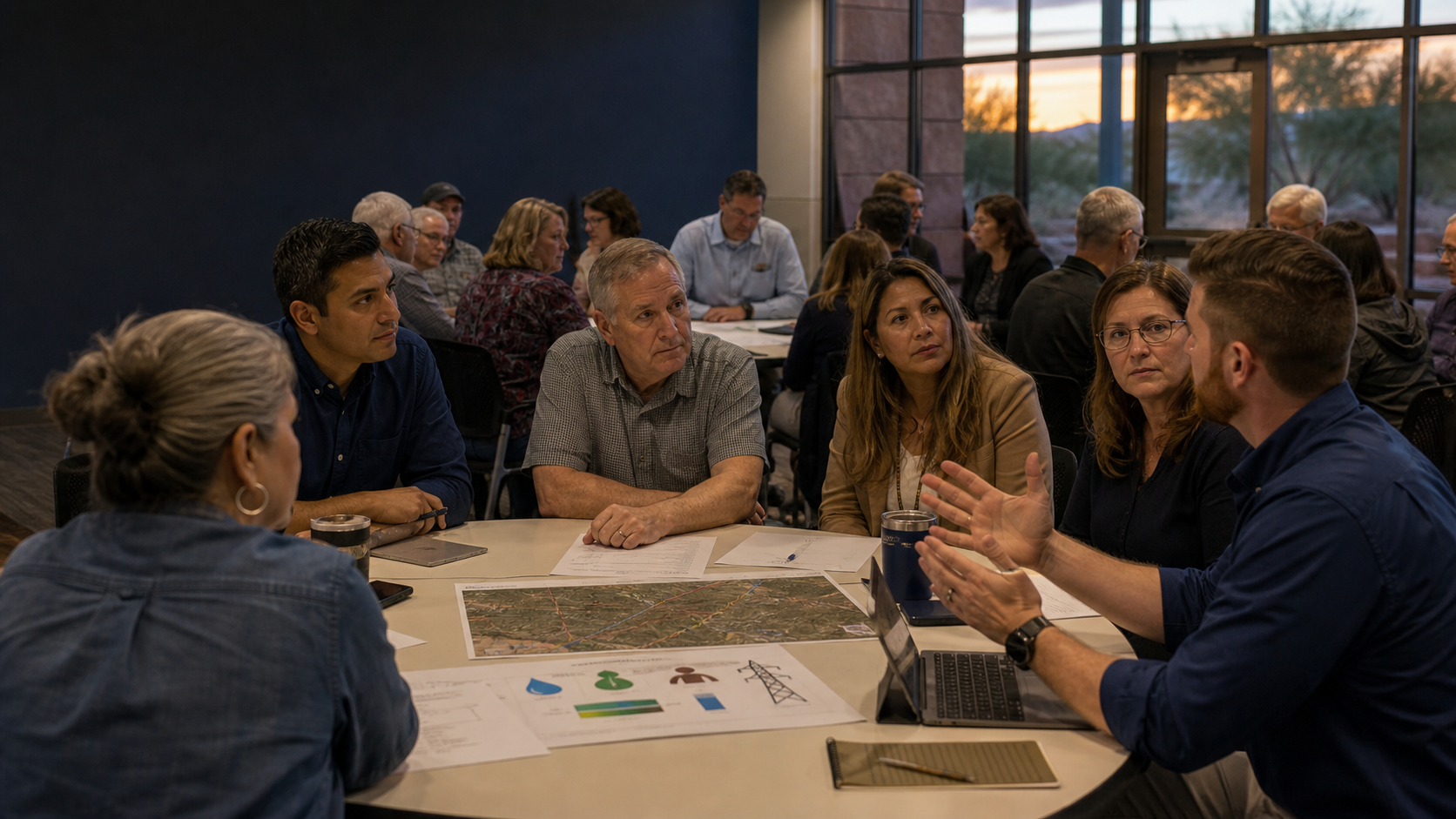
For years, the case for data centers was made with charts: tax base, jobs, uptime, sustainability metrics. Those numbers still matter. But they aren't where most community conversations start anymore.

Today, people in Arizona and across the country are talking about data centers in much more personal terms: their water, their power bills, the desert next to their neighborhood, the noise down the road. Opposition groups are organized, coordinated, and growing. They aren't always wrong, and they aren't going away.

AZDCA's position is simple: we meet our neighbors where they are. We listen first, we answer honestly, and we publish the numbers, good and bad, so anyone can check our work.

This page is a living resource. If you see something that needs a correction, a better source, or a local context we've missed, tell us. We'd rather be right than defensive.
Concerns & Answers

The Questions We Hear Most

Every concern below comes from a real community conversation. We don't dodge them. We address them with what we know today.

Water

The Concern

"Data centers are drinking our aquifer dry in the middle of a drought."

What's Actually Happening

Arizona water policy is public and strict. New large commercial users operating in Active Management Areas must demonstrate an assured 100-year water supply before building, and most Phoenix-metro data centers now use closed-loop or air-cooled designs that dramatically reduce on-site water draw compared to older facilities.

That doesn't mean water use is zero, and it doesn't mean every site is equal. AZDCA is pushing members to publish facility-level water numbers so residents can compare. If a project can't explain its water plan plainly, that's a fair reason to ask harder questions.

Power & Your Bill

The Concern

"Data centers are raising my electricity bill so tech companies can train AI."

What's Actually Happening

Residential rates in Arizona are regulated by the Arizona Corporation Commission, not by private operators. Large commercial customers like data centers negotiate their own service agreements, and in most cases they fund new transmission, substation, and generation infrastructure that wouldn't otherwise get built.

The honest tension: load growth is real, and utility planning hasn't always kept up. That's a legitimate public-interest conversation, and it should happen in rate cases where everyone can be heard, not in a vacuum.

Land & Desert

The Concern

"We're paving over the Sonoran Desert for warehouses full of computers."

What's Actually Happening

The overwhelming majority of Arizona data centers are built on previously zoned industrial or commercial land inside established metro corridors, not on protected desert or open space. Site selection is driven by power and fiber, which means building where infrastructure already exists.

Where new development touches sensitive habitat, that's a planning-and-zoning question. Residents have every right to show up at those hearings, and AZDCA supports transparent local review.

Jobs Beyond Construction

The Concern

"Data centers only employ a handful of people once they're built."

What's Actually Happening

The headcount inside a single building is smaller than a factory. That part is true. But a modern data center campus supports a wide ecosystem: electricians, mechanical techs, controls engineers, security, fiber techs, facilities, construction trades, and the dozens of service vendors that keep 24/7 operations running. These are middle-skill, middle-wage Arizona jobs that don't require a four-year degree.

That's exactly why AZDCA exists. Read about our workforce pipeline programs with Maricopa Community Colleges, EVIT, and industry partners.

Noise & Neighborhood Impact

The Concern

"The chillers and generators are loud, and nobody warned us."

What's Actually Happening

This one is a legitimate and fixable issue. Cooling equipment and backup generator testing are real sources of noise, and some early-generation sites were not designed with close residential neighbors in mind. Newer builds use acoustic enclosures, setbacks, and monitored generator-run windows.

If you're a neighbor to an existing site and something isn't right, we want to know. We'll connect you with the operator. No runaround.

Tax Incentives

The Concern

"Big tech gets a sweetheart tax deal while our schools go without."

What's Actually Happening

Arizona's Computer Data Center Program offers sales-tax relief on qualifying equipment, but property tax (the portion that funds local schools and municipal services) is not waived. Data centers remain some of the highest per-acre property tax contributors in the cities where they operate.

Whether any particular incentive is the right deal for a community is a fair policy debate. AZDCA's role is to make sure the numbers in that debate are accurate.

Our Commitment

How AZDCA Shows Up

Listen First

We show up at town halls, HOA meetings, and school boards, not just industry conferences.

Publish the Numbers

Water, power, tax contribution, workforce impact, published plainly and sourced.

Hire Locally

Career pathways for Arizona residents through Maricopa Colleges, EVIT, and our partner programs.

Answer Honestly

Residents get a real person, a real email back, and a real answer, not a press release.

Arizona & Southwest

Get in the Room

The decisions shaping data center policy in Arizona are being made in public forums. These are the recurring series and organizations where you can listen, comment, or testify. Most are free and open to all.

Monthly Series

Arizona Energy Consortium Forums

In Person + Virtual

Monthly forums on energy policy, utility rates, and data center impacts. ACC commissioners appear regularly.

Monthly, 8-10am MST Phoenix metro + Zoom
arizonaenergyconsortium.com
Regulatory

AZ Corporation Commission

Public

Monthly open meetings + active data center docket E-00000A-25-0069 generating ongoing workshops on who pays for grid buildout.

Monthly + ad hoc 1200 W. Washington, Phoenix
Annual

ASU Data Center Knowledge Exchange

Free

Full-day forum with operators, utilities, policymakers, and academics. Energy, water, and heat topics. Hosted at ASU Tempe.

Annual, February Walton Center, Tempe
asuevents.asu.edu
Annual

Arizona Technology Council

Statewide

TechFusion AI/IT conference (March, GCU Phoenix) and Cybersecurity Summit (May), both co-hosted with the Arizona Commerce Authority.

March + May Phoenix
aztechcouncil.org
Policy

AAED Phoenix Summit: Policy Exchange

Annual

Data center track alongside land-use and economic development. City staff and planners in the room, not just industry.

Annual, March Phoenix
aaed.com
Annual

Arizona Tech Week

Statewide

100+ sub-events statewide each April including data center-focused sessions. Arizona Commerce Authority umbrella.

Annual, April Statewide
azcommerce.com

Known Upcoming

May
20
ATC Cybersecurity Summit
Phoenix, AZ · Arizona Technology Council
Register
May
21
Southwest Energy Conference
The Clayton House, Scottsdale · AEC
Register
Ongoing
ACC Data Center Docket
Phoenix + Virtual · Docket E-00000A-25-0069
Track docket

See something missing? Let us know. We update this as Kirk tracks the calendar.

Get Involved

Have a Question? Ask It.

Live near a data center? Writing a local story? Weighing a zoning vote? Teaching your students about Arizona's infrastructure? Start a conversation with us.