How It Works
What's Actually Inside a Data Center.
Not a career pitch. If you're trying to understand the building going up near your house, this is the plain-language version. Five parts, no jargon.
Not a career pitch. If you're trying to understand the building going up near your house, this is the plain-language version. Five parts, no jargon.
This is a utility. It just doesn't look like one from the road.
The tower on the side of the road hands off almost instantly. Once you're talking, texting, or streaming, the traffic is riding fiber into a data center within milliseconds. Not a satellite. Rarely even that tower, past the last few hundred feet.
The map, the live traffic, the reroute when you miss a turn, all recalculated in a data center hundreds of miles away, not inside your phone.
911 dispatch records, hospital patient monitoring alerts, water and grid control systems. The systems that respond when something goes wrong run here too.
Even the utility that keeps your lights on relies on this kind of infrastructure. Grid monitoring, load balancing, and outage response all run on systems like these.
None of this is an argument for waving through every project. It's context for why the conversation matters: this infrastructure already touches daily life more than most people realize, which is exactly why the siting, the design, and the community process around a specific project are worth real scrutiny.
Projects vary in size and design. Every one of them has these five things in some form.
Electricity comes in from a utility substation on or near the property. The building pays for what it uses under its own agreement, the same way any large commercial customer does. Backup batteries and generators keep things running through a short outage.
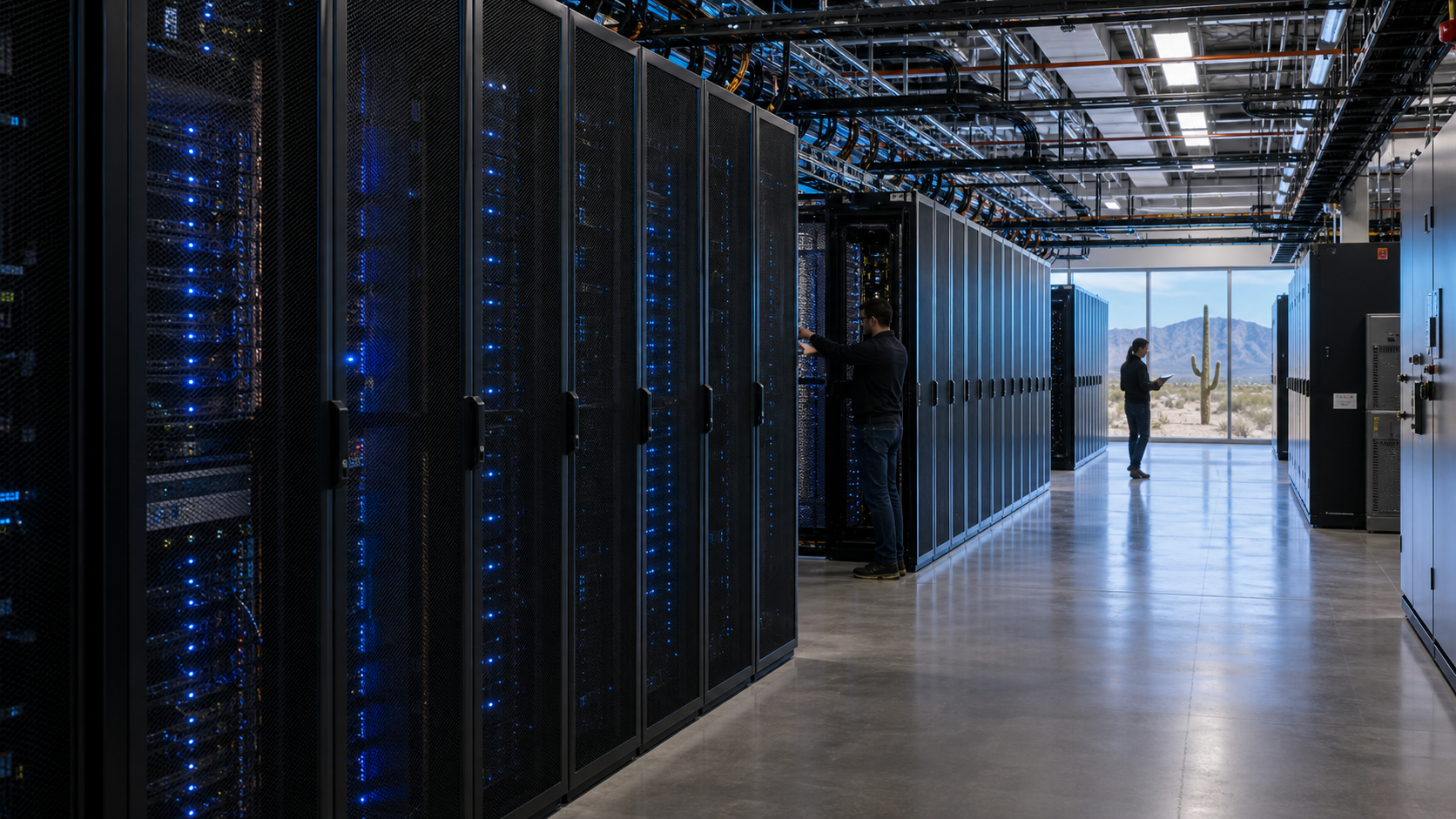
Rows of racks holding servers, the machines that actually store data and run software. This is the part most people picture when they hear "data center," and it's usually a small fraction of the building's footprint.
All those computers make heat, and it has to go somewhere. Some designs move it out with air and a sealed water loop that never touches the outside, what people mean by "closed-loop." Others use a small amount of water evaporating, similar to a swamp cooler, because it's more efficient in dry heat. The design a project uses is exactly what determines its water footprint, which is why it's worth asking about directly. See the water section on our Community & Facts page for how to score a project's answer on this.
Fiber cables connect the building to the rest of the internet. Most sites run multiple routes in and out, so one cut cable doesn't take a hospital's records or a 911 system offline.
Fencing, cameras, and controlled access, because a lot of sensitive information, financial, medical, and personal, lives inside. This is also most of why you won't get a walk-through tour on short notice.
Every one of these depends on a data center somewhere, possibly one near you.
Careers, credentials, and who to talk to in Arizona live on our Data Center 101 page.